History & Culture
The Independence Monument: What It Is and What Happens There
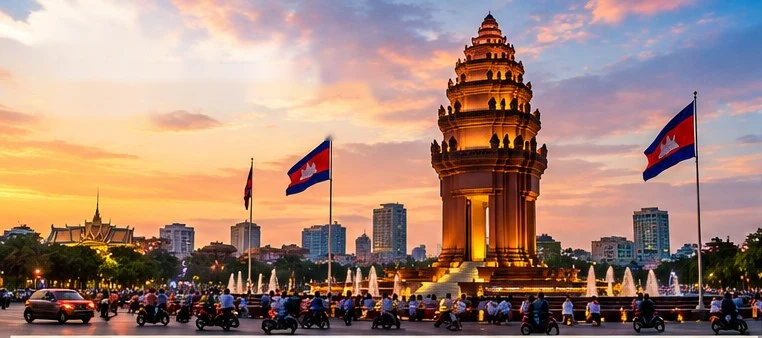
At the roundabout where Norodom and Sihanouk Boulevards meet stands the Independence Monument, the lotus-shaped tower at the centre of Cambodia's Independence Day every 9 November.
What the monument is
The Independence Monument, called Vimean Ekareach in Khmer, stands on a large roundabout where Norodom Boulevard meets Sihanouk Boulevard in central Phnom Penh. It is a tall, tiered tower shaped like a lotus bud, built in the form of a stupa and modelled on Khmer temple architecture, above all the temple of Banteay Srei near Angkor. Its height is usually given as 37 metres.
The monument is made of reinforced concrete standing on a platform supported by piles. According to a detailed 2003 history in the Phnom Penh Post, the builders finished it with crushed red marble instead of sandstone to give it a colour similar to Banteay Srei. Grey marble covers the steps and the surrounding precinct, and the "flame" at the top was ordered from a French goldsmith. The same article stresses that the design is inspired by Banteay Srei but is "no pastiche copy".
Why it was built
Cambodia's independence from France is dated to 9 November 1953, when power was transferred to Cambodian hands in a ceremony in front of the Royal Palace. It ended about ninety years of French rule, and the campaign for it was led by King Norodom Sihanouk.
The monument was built to commemorate that recovery of sovereignty, which the Phnom Penh Post describes as achieved "without blood being drawn." The plan was larger than a single tower: Sihanouk Boulevard, the naga fountains and the lotus basins around the site were laid out as part of the same commemoration. In the decades since, after years of war, the monument has also come to be treated as a memorial to Cambodians who lost their lives for the country.
Who designed it
The monument is widely credited to Vann Molyvann (1926–2017), the Cambodian architect who returned home from his studies in France in 1956 and was soon appointed head of public works and state architect. He became the best-known figure of what is now called New Khmer Architecture, which combined modern building methods with forms drawn from Khmer tradition. His other well-known works in Phnom Penh include the National Olympic Stadium.
The full story of its authorship is less tidy. The Phnom Penh Post reported that the city government under Governor Tep Phan organised a national competition for the monument, and that blueprints dated 25 March 1957, drawn by Du Ngoc Anh and signed by the engineer Ing Kieth, had been found in the National Archives. The sculptors Tan Veut and Chieng Suon also worked on it, and Kong Sam Ol, interviewed for the article, described it as the work of a team.
Nine years from independence to opening
Construction is generally dated to 1958, and the monument was officially inaugurated by Norodom Sihanouk on 9 November 1962, the ninth anniversary of independence. Why it took so long has long been debated. Those interviewed by the Phnom Penh Post pointed to the ground: the land east of Norodom Boulevard had been wetland when the French arrived, and the first contractor's foundation piles failed, which caused a delay of about two years. New tender documents had to be drawn up, and by 1959 the structure was complete but the sculpture was not.
Other evidence complicates the picture. The same article notes a photograph, published in 1961, that appears to show the monument already complete in 1957. In his inauguration speech, as recalled in that article, Sihanouk argued that the key to protecting Cambodia's independence lay not in having a big army but in the unity of its people.
What happens there on 9 November
Independence Day is a fixed public holiday in Cambodia. In 2026 it falls on Monday 9 November, the 73rd anniversary; on the Khmer lunar calendar that day is the 14th waning day of Assoch. The main national ceremony takes place at the Independence Monument.
News reports from recent years describe a consistent pattern. King Norodom Sihamoni presides, with the leaders of the Senate, the National Assembly and the government, foreign diplomats, civil servants and members of the armed forces in attendance. The King lays a wreath and lights a ceremonial flame, often called the victory flame or victory torch, inside the monument. Reports from 2017 and 2024 say the flame is kept burning for three days. White doves or pigeons and balloons are released, and fireworks have been held in the evening in front of the Royal Palace.
The exact programme, guest list and timing change from year to year, and the roads around the roundabout are busy at the best of times. Anyone hoping to watch should follow official announcements and expect traffic controls on the day.
The rest of the year
Outside the ceremony, the monument is part of everyday Phnom Penh. At night it is lit in the red, blue and white of the national flag. The park and plaza beside it are used for walking, jogging and evening exercise, and just behind the monument stands the Norodom Sihanouk Memorial, with a statue of the late King Father, built in 2013. The Royal Palace is a short walk away.
Because the monument stands in the middle of a busy traffic circle, it is best viewed from the park side, and pedestrians need to take care crossing. It remains a national memorial, so visitors are expected to behave quietly and respectfully, especially during official events.
Our Cambodia Independence Day guide covers the holiday itself, and the Cambodian public holidays list shows where 9 November sits in the official 2026 calendar. Two weeks later comes the Water Festival (Bon Om Touk), from 23 to 25 November 2026. To see the Khmer lunar date for any day, use the Khmer Calendar.
Related articles
Frequently asked questions
When is Cambodia's Independence Day in 2026?
Independence Day is always on 9 November. In 2026 it falls on a Monday and marks the 73rd anniversary of independence from France in 1953. It is on Cambodia's official list of public holidays.
Who designed the Independence Monument?
It is widely credited to the Cambodian architect Vann Molyvann. Historical research reported by the Phnom Penh Post shows that other designers, engineers and sculptors also took part, after a national competition organised by the Phnom Penh city government.
When was the Independence Monument built?
Work is usually dated to 1958, and the monument was officially inaugurated on 9 November 1962, nine years after independence. Foundation problems on former wetland are one reason given for the long gap.
What is the flame lit at the monument on Independence Day?
During the national ceremony, the King lights a ceremonial flame, often called the victory flame or victory torch, inside the monument. News reports from 2017 and 2024 say it is kept burning for three days.
Sources and further reading
- Phnom Penh Post: “The enigma of the Independence Monument” (7 November 2003) — the most detailed history used here: materials, the competition, the 1957 blueprints, foundation problems, the 1962 inauguration and the 1953 handover in front of the Royal Palace.
- Wikipedia: Independence Monument (Cambodia) — location, lotus-shaped stupa design after Banteay Srei, height, construction dates and the nearby Norodom Sihanouk Memorial.
- Wikipedia: Vann Molyvann — the architect's life dates, his 1956 return and appointment as state architect, and New Khmer Architecture.
- Rusty Compass: Independence Monument, Phnom Penh — travel guide noting Vann Molyvann's design and the monument's later role as a memorial to lives lost in war.
- Inquirer.net (AFP): “Cambodia marks 64th anniversary of independence from France” (9 November 2017) — report of the ceremony: wreath, victory flame kept burning for three days, doves and balloons, fireworks at the Royal Palace.
- The Star: “Cambodia marks Independence Day” (10 November 2022) — the King presiding at the monument, laying a wreath and lighting the victory fire.
- Thailand Public Relations Department: “Cambodia Celebrates 71st Independence Day with Grand Ceremony” (2024) — the 2024 ceremony: wreath, victory torch burning for three days, attendees, balloons and pigeons.
- Cambodianess: “The Independence Monument in Phnom Penh: A Symbol of Cambodia's Resilience” (28 November 2025) — the Khmer name Vimean Ekareach, night lighting in the flag's colours and everyday use of the park around the monument.
Ceremony programmes, road closures and access around the monument change from year to year. Check official announcements before planning a visit on 9 November.
Explore more: Cambodia Independence Day · Cambodian Public Holidays · Water Festival (Bon Om Touk) · Khmer Calendar
← Back to the MyBirthSign Blog