Buddhist Traditions
Kathen: Cambodia's Robe-Offering Season After Buddhist Lent
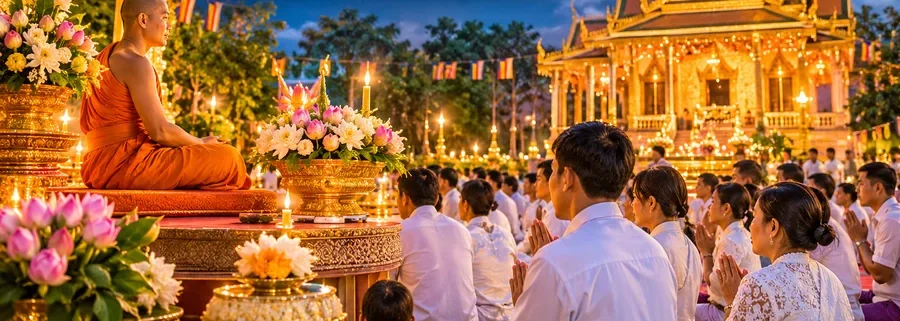
For about a month after the rains retreat ends, pagodas across Cambodia hold Kathen, the ceremony in which lay people offer new robes to the monks.
What Kathen is
Kathen (also written Kathin, from the Pali word kathina) is the Theravada Buddhist ceremony held after Vassa, the three-month rains retreat that Cambodians call Chol Vassa. During the retreat, monks stay in their own monastery. Once it ends, lay supporters bring cloth and new robes to the monks who completed it, together with other gifts for the pagoda.
The word kathina refers to a frame. In the traditional story, a wooden frame was used to hold pieces of donated cloth in place while the monks sewed them into a single robe. The ceremony keeps that name even though most robes offered today are already made.
The story behind it
Buddhist texts tell of thirty monks who were travelling to spend the rains retreat with the Buddha. The rains began before they arrived, so they had to stop and spend the retreat at Saketa instead. When the retreat ended, the Buddha gave them a donated cloth to make into one robe, which they offered to one monk in their group. That occasion became the model for the annual robe offering.
When Kathen happens in Cambodia
Kathen has a fixed window on the Khmer lunar calendar. It opens on the first waning day of the month of Assoch, the day after Chenh Vassa marks the end of the retreat, and closes on the full moon of Kadeuk. That is roughly one month, starting about two weeks after Pchum Ben.
In 2026, Chenh Vassa falls on Monday 26 October, so the Kathen season runs from 27 October to 24 November 2026. These dates come from the same Khmer lunar calendar that powers our Khmer Calendar. The last day of the season, the full moon of Kadeuk, falls during the Water Festival (23–25 November 2026).
Each pagoda holds its own Kathen on one day within that window, chosen by the pagoda and its supporters. That is why you may see processions on many different days across the month rather than on a single national date.
What people offer
The heart of the offering is a set of robes. A 2000 report in The Cambodia Daily described a standard set as a robe, a sarong, a belt and an alms bowl, and quoted a religious expert saying that a set of saffron robes is enough to make a Kathen. At the pagoda it described, the largest package went to the chief monk and smaller packages to his deputies, while other monks and novices also received gifts.
Alongside the robes, families and communities usually give money and practical items. Kathen is also an important time for raising money for building work and repairs at pagodas, which is why the same report described the season as a time for rebuilding.
The monastic rules behind the ceremony
Kathen is not only a festival; it is also a formal act within the monastic code. According to Thanissaro Bhikkhu's Buddhist Monastic Code, the cloth must come from a donor outside the community of monks and be given to the community as a whole. The monks then agree which of them will receive it, and the robe must be made on the day it is donated. The formal act needs a quorum, meaning at least five monks taking part, and the monk who receives the cloth must have spent the whole rains retreat without a break.
By long-standing tradition, each monastery receives only one Kathen offering in a season. This is why a pagoda's supporters coordinate around a single Kathen day rather than holding several.
What a Kathen day looks like
Many Kathen days begin with a procession. Supporters carry the robes and gifts to the pagoda, often with traditional musicians and dancers. The 2000 Cambodia Daily report described a procession that circled the temple three times before entering, after which a senior monk thanked the givers and the crowd moved on to share a meal.
Kathen also brings people home. The same report described more than 3,000 people arriving at one pagoda by truck, including city residents who returned to their home villages for the day. For many families it is a chance to support the pagoda they grew up with.
- Royal Kathen: the King also presents Kathen offerings each year. For example, the King's official website records a royal Kathen ritual held at the Royal Palace on 11 October 2022 for the monks of Svay Popè Pagoda in Phnom Penh.
- Community Kathen: villages, families, workplaces and associations often organize their own offering to a pagoda they choose, and the date is announced locally.
If you are invited to a Kathen
Visitors are usually welcome. Dress modestly with shoulders and knees covered, take off your shoes before entering the main hall, and sit so that your feet do not point toward the monks or the Buddha image. Any contribution is voluntary; as one chief monk told the Cambodia Daily, givers and receivers gain the same merit whether the gift is small or large. If you are unsure what to do, follow the people around you or ask the organizers.
Kathen, Chenh Vassa and Pchum Ben are different
These three observances fall close together and are easy to mix up. Pchum Ben (10–12 October 2026) is a public holiday for honoring ancestors. Chenh Vassa (26 October 2026) marks the end of the monks' rains retreat. Kathen is the month-long season that follows, when each pagoda holds its own robe-offering day. Of the three, only Pchum Ben is an official public holiday.
Related articles


Frequently asked questions
When is Kathen in 2026?
The Kathen season runs from 27 October to 24 November 2026, from the first waning day of Assoch to the full moon of Kadeuk. Each pagoda chooses one day within that period.
What is offered at Kathen?
The core offering is a set of robes for the monks. Families and communities also give money and practical items, often for repairs and building work at the pagoda.
Is Kathen a public holiday in Cambodia?
No. Kathen is a religious season, and pagodas hold their ceremonies on different days. Pchum Ben and the Water Festival, which fall before and at the end of the season, are public holidays.
Can visitors take part?
Yes, visitors are usually welcome. Dress modestly, remove your shoes before entering the main hall and follow the organizers' lead. Any gift is voluntary.
Sources and further reading
- Wikipedia: Kathina — overview of the festival, the origin story at Saketa and the meaning of the word.
- Thanissaro Bhikkhu, The Buddhist Monastic Code, Chapter 17 — the monastic rules for the kathina: timing, quorum, the donor and making the robe the same day.
- The Cambodia Daily: “Kathen Holiday Season a Time for Rebuilding” (26 October 2000) — a first-hand account of a Kathen day in Cambodia: offerings, procession and village participation.
- Official website of King Norodom Sihamoni: “The ritual Ang Kathen” (11 October 2022) — record of a royal Kathen ritual for Svay Popè Pagoda.
- Cambodgemag: “Cambodia's annual Kathina celebration begins tomorrow” (17 October 2024) — describes the season as running from the first waning day of Assoch to the full moon of Kadeuk.
Dates for lunar observances follow the Khmer lunar calendar and can differ by a day locally. Check with your pagoda or official announcements for exact times.
Explore more: Chol Vassa (Buddhist Lent) · Cambodian Buddhist Holy Days · Water Festival (Bon Om Touk) · Cambodian Public Holidays
← Back to the MyBirthSign Blog