Chinese Zodiac Guide
Zodiac Clashes Explained: Why One Sign Takes It Easy Each Day
Every daily fortune on this site names one sign that should take it easy. That sign is never chosen at random: it is the animal sitting directly opposite the day's animal on the zodiac circle. Here is how that traditional idea works.
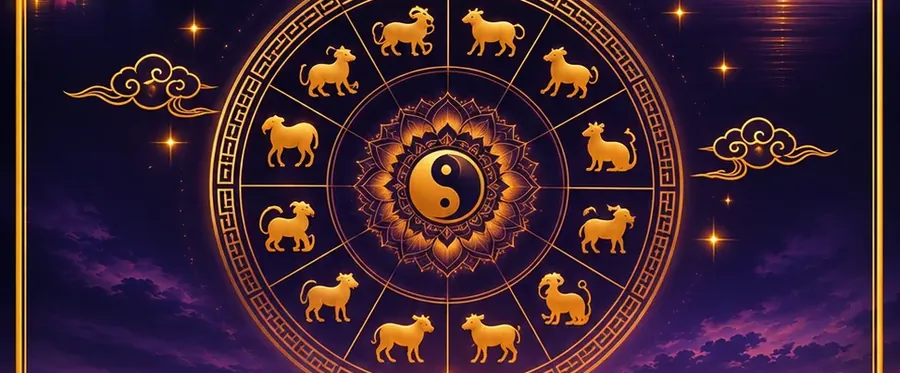
The zodiac as a circle
The twelve animals of the Chinese zodiac are usually drawn as a circle, in a fixed order: Rat, Ox, Tiger, Rabbit, Dragon, Snake, Horse, Goat, Monkey, Rooster, Dog and Pig. Each animal belongs to one of the twelve Earthly Branches, the same twelve signs that the Chinese calendar uses to count years, months, days and hours, as the Hong Kong Observatory explains in its guide to the Heavenly Stems and Earthly Branches.
Because the animals sit on a circle, every sign has neighbours, signs four places away that form a triangle with it, and one sign directly across the circle, six places away. Traditional compatibility is built on those positions. Signs in the same triangle are said to support each other. Signs directly opposite each other are said to clash.
The six clash pairs
Twelve signs make six opposite pairs. The guide to zodiac compatibility published by Chinese Idioms describes the rule simply: to find a sign's clash partner, look directly across the circle, six positions away. The six pairs are:
- Rat and Horse
- Ox and Goat
- Tiger and Monkey
- Rabbit and Rooster
- Dragon and Dog
- Snake and Pig
In Chinese these are known as the six clashes (liu chong). The same guide lists the four supportive triangles that sit alongside them: Rat, Dragon and Monkey; Ox, Snake and Rooster; Tiger, Horse and Dog; and Rabbit, Goat and Pig. Notice that the two signs of a clash pair never share a triangle.
Why a clash is about days, not only people
The clash idea is not only used to compare two people. It is also applied to time. The Chinese almanac gives an animal for every day. A South China Morning Post article on clashes explains that the almanac lists the animal that characterises each day, and that readers compare it with their own birth-year animal, for example so that a couple can avoid a wedding day that clashes with their birth year.
Seen this way, a clash is a property of the day rather than a judgement about a person. One guide to almanac data puts it plainly: the clash is a property of the day, not of the reader. Its example for 1 October 2026 gives the day pillar Wu-shen, which is a Monkey day, and names the Tiger as the animal that traditionally stays away from that date. Tiger and Monkey are one of the six pairs.
How our daily fortune uses it
Our daily fortune follows the same traditional pattern for every sign, every day. First it finds the day's animal from the continuous day cycle (our guide How the day's animal is found explains how). Then each sign gets one of four ratings:
- Great Day: the sign is the day's own animal.
- Good Day: the sign shares a triangle with the day's animal.
- Take It Easy: the sign sits directly opposite the day's animal, the clash.
- Ordinary Day: every other sign.
So on a Horse day, people born in the Year of the Rat are told to take it easy; on a Rat day, it is the Horse. Because the day's animal moves on by one place every day, each sign meets its clash once every twelve days, and the Take It Easy message rotates around the whole zodiac.
Take it easy does not mean bad luck
In the tradition, a clash day is a day to slow down rather than a day to fear. The advice that goes with it is practical: avoid rushing big decisions, double-check details, choose gentle words, and leave important launches or signatures for a stronger day. That is also the tone of our own Take It Easy cards and videos: a quiet day is not a bad day.
It also helps to remember what a clash day is not. It does not say anything about you as a person, and it does not last: twelve days later the same sign has its own Great Day. The zodiac is a cultural tradition for reflection and fun, not a scientific forecast, so treat a clash day as a gentle reminder rather than a rule.
Clashes between people
The same pairs appear in compatibility charts. Two people whose signs clash, for example a Rabbit and a Rooster, are traditionally said to need more patience and understanding with each other, while signs in the same triangle are said to get along more easily. Our zodiac compatibility guide and the compatibility calculator show these relationships for any two signs.
Many happy couples, friends and business partners have clashing signs. Traditional compatibility is best read as a conversation starter about how two people work together, not as a verdict.
Quick reference: when each sign takes it easy
Each sign's Take It Easy day is the day of its opposite animal:
- Rat: on Horse days, and Horse on Rat days
- Ox: on Goat days, and Goat on Ox days
- Tiger: on Monkey days, and Monkey on Tiger days
- Rabbit: on Rooster days, and Rooster on Rabbit days
- Dragon: on Dog days, and Dog on Dragon days
- Snake: on Pig days, and Pig on Snake days
To see which animal rules today, open the latest daily fortune: the top of the page names the day's animal, the luckiest signs and the sign to take it easy.
Related articles


Frequently asked questions
What is a clash in the Chinese zodiac?
A clash is the traditional relationship between two signs that sit directly opposite each other on the zodiac circle, six places apart. There are six clash pairs, from Rat and Horse to Snake and Pig.
Why does one sign have to take it easy every day?
Every day has its own animal in the traditional day cycle. The sign opposite that animal is in a clash with the day, so it is traditionally advised to slow down and avoid big decisions.
Is a clash day bad luck?
Not in the sense of something to fear. It is a traditional reminder to be careful and patient. The same sign has its own Great Day twelve days later.
Can people with clashing signs be good partners?
Yes. Clashing signs are traditionally said to need more patience with each other, but compatibility charts are a cultural guide, not a rule, and many partners with clashing signs get along well.
Sources and further reading
- Chinese Idioms: “Chinese Zodiac Compatibility: The Trines, the Clashes, and Your Best Match” (15 July 2026) — lists the six clash pairs (signs six places apart on the circle) and the four trines.
- South China Morning Post: “Clash course” — the Chinese almanac (Tong Seng) gives the animal of each day; people compare it with their birth-year animal, for example to avoid a clashing wedding day.
- RoxyAPI: “Is There a Chinese Almanac API? Tong Shu Data Explained” (26 August 2026) — describes the day's clash animal as a property of the day; its example gives the day pillar Wu-shen and the clash animal Tiger for 1 October 2026.
- Hong Kong Observatory: “Heavenly Stems and Earthly Branches” — the 60-part Gan-Zhi cycle, its use for years, months, days and hours, and the twelve two-hour periods with their clock times.
Traditional Chinese zodiac reading for culture and entertainment, not a scientific prediction. Dates follow the published calendars cited above.
Explore more: Zodiac compatibility guide · How the day's animal is found · The 12 zodiac hours · Compatibility calculator
← Back to the MyBirthSign Blog